
How climbers perform welding work at height
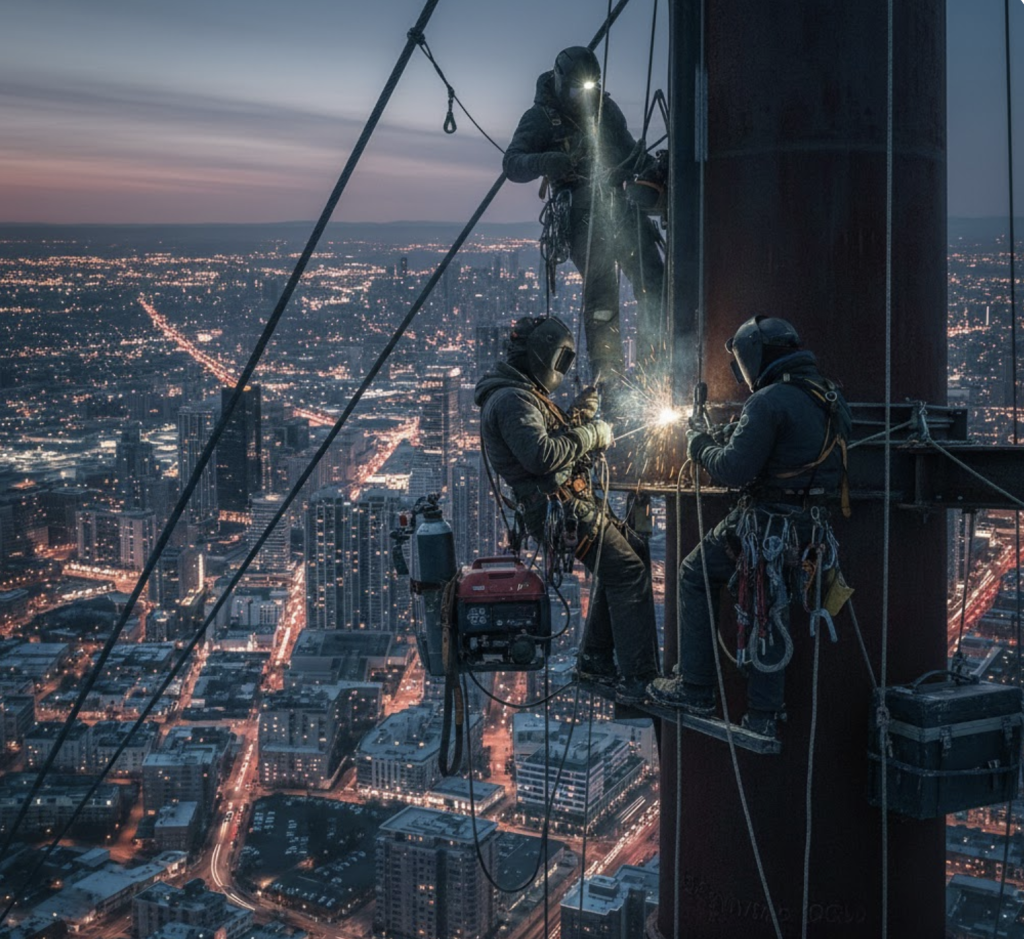
Industrial climbing has long gone beyond window cleaning and facade insulation. Today, it is a high-tech industry, where the most difficult stage is considered to be the performance of welding work at height. When you need to repair a chimney, reinforce the frame of a TV tower, or install an advertising structure on a skyscraper, conventional methods (scaffolding or aerial platforms) become either too expensive or technically impossible. That’s when specialists who are equally skilled with both a descent device and a welding torch come into play.
Working at height with open flames or electric arcs defies the laws of physics. The main difficulty lies in the fact that the climber is in an unsupported space. Every movement causes swaying, and the recoil from the electrode touching the metal can push the worker away from the work area. Add to this gusts of wind that blow away the protective gas or knock down the arc, and you have conditions in which a routine welding operation becomes precision work.
Equipment: what a climber takes with them to the “sky”
Preparing equipment for high-altitude welding is an art form in itself. A standard climber’s kit is supplemented with specific tools that must be as compact and protected as possible. Manual arc welding (MMA) is most often used due to the mobility of inverters, but semi-automatic machines are also used on stable objects.
The basic arsenal of a high-altitude welder includes:
- Inverter welding machine: It should be lightweight, with arc stabilization and long cables.
- Fireproof belay system: Regular nylon ropes and slings melt at the first spark. Therefore, special protectors for ropes and belays with a steel core or Kevlar coating are used.
- Specialized Chameleon mask: It attaches directly to the helmet so that climbers can move their heads freely without risking losing protection.
- Magnetic clamps and vices: Help secure parts before welding, as the craftsman does not have a “third hand” to hold the metal.
- Dielectric mats and insulation: To prevent electric shock through wet ropes or metal structures of the building.
Process technology and safety
Safety at height when working with hot metal (the arc temperature reaches 3000-4000°C) requires strict adherence to protocols. The smallest spark falling down can cause a fire on the ground or damage the pipelines below. Therefore, the working area is always fenced off, and special spark arrestors or fireproof screens are installed under the welding site.
Special attention is paid to protecting the climber himself. His suit is made of thick canvas or split leather, which do not support combustion. However, the main danger is damage to the main rope. Even microscopic damage to the rope’s structure reduces its strength by 50-70%, which can lead to tragedy during descent.
Algorithm for preparing for high-altitude welding
To ensure that the work is done properly and the climber returns to the ground unharmed, each trip to the site is accompanied by careful preparation. This is not a case where you can rely on luck.
Sequence of actions to be taken by a specialist before starting work:
- Weather conditions assessment: At wind speeds exceeding 10-12 m/s or during precipitation, high-altitude welding work is strictly prohibited.
- Grounding check: The welding machine and the structure itself must be securely grounded to prevent stray currents through the safety equipment.
- Organization of suspension points: Independent anchor points are installed for the technician and separately for lifting equipment (inverter and cylinders, if necessary).
- Cleaning the work surface: Removing rust, paint, and old coatings at height takes longer than the welding itself, but it is critical for the strength of the joint.
- Installation of fire protection: Checking that the climber and his backup on the ground have fire extinguishers.
High-altitude welding is a symbiosis of physical endurance, metallurgical knowledge, and survival skills in extreme conditions. Only certified specialists who have undergone double training (as welders and industrial climbers) are allowed to perform such tasks. It is difficult but extremely important work, thanks to which our cities continue to grow upward while remaining reliable and safe.
Interesting articles:
What are the specifics of painting metal at height with the help of climbers?
Why clean the drainage system from ice and icicles?