
Lifting loads to heights for repair work: is it possible to do without heavy equipment?
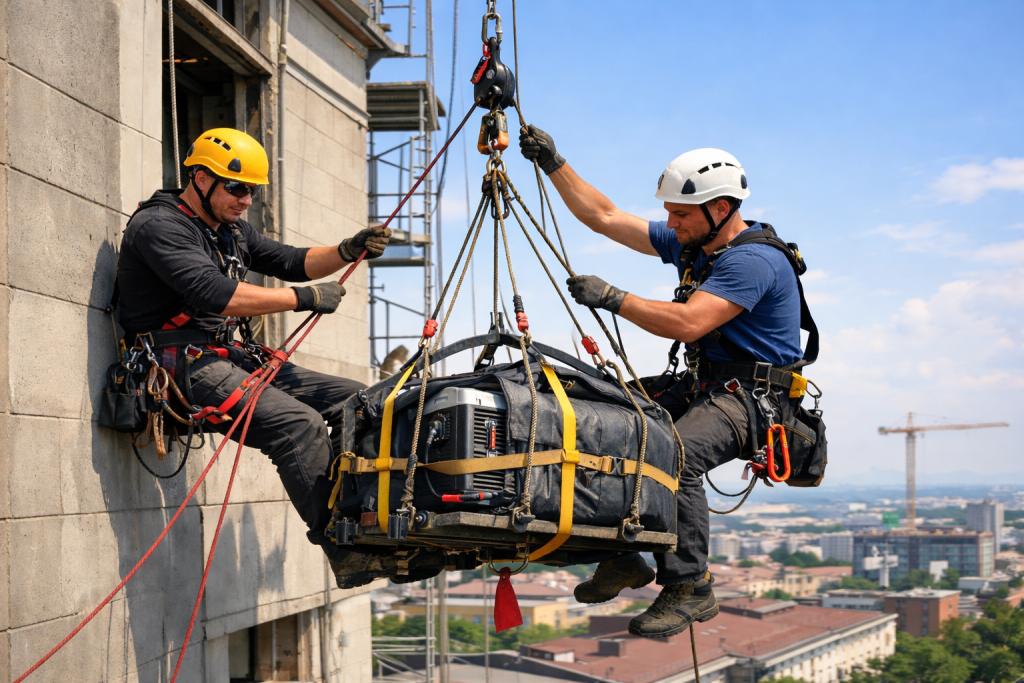
During facade or roof repairs, it is often necessary to lift materials, double-glazed windows, metal structures, or tools to a height. The usual solution seems to be to use a crane or a cherry picker. But in practice, this is not always possible: the equipment requires space, access, approval, and creates unnecessary costs. In such cases, it is more expedient to choose an alternative — the work of industrial climbers.
Why heavy equipment is not always suitable
Heavy equipment refers to cranes, manipulators, or aerial platforms that lift large or heavy objects. However, even for small buildings, the conditions for their use are not always available. In dense urban areas, narrow courtyards, or on the roofs of old buildings, the equipment simply cannot pass or will not receive permission for placement.
Typical restrictions that make the equipment unsuitable:
- limited access to the property or inability to drive up to it;
- lack of sufficient space for installing a crane or tower;
- a large number of communications or trees near the building;
- the need to work at night or on weekends when equipment is not permitted;
- High cost of renting special equipment for a small amount of work.
In such situations, a team of climbers can complete the ascent faster, without unnecessary approvals and noise.
An alternative to technology — industrial climbing
Industrial climbers use a system of ropes, winches, and safety equipment that allows them to safely lift loads to heights even in difficult conditions. This is particularly effective when working on roofs, facades, and balconies, where it is necessary to lift glass panes, air conditioners, decorative elements, or repair materials.
The use of special rigging equipment allows you to control the angle of inclination and smoothness of movement of the load, minimizing the risk of damage. The main advantage is independence from the technical limitations of the site.
- Cargo weight — climbers can lift up to 200–300 kg without special equipment.
- Dimensions — if the item fits through a window or balcony opening, no equipment is required.
- Height — lifting up to 100 m is carried out using industrial systems.
- Condition of the facade — presence of mounting points or possibility of temporary installation of rollers.
- Safe zone below — is there space for fencing and controlling the movement of people?
- Weather conditions — no strong winds or precipitation.
- The type of work — installation, replacement, or lifting of tools — allows for different methods.
Process safety and control
Lifting loads by industrial climbers is always accompanied by strict adherence to safety rules. Before starting work, the danger zone is cordoned off, warning signs are installed, and carabiners, ropes, and winches are checked. Each load is secured at two points to prevent swaying. All work is performed with safety measures in place, according to agreed plans and under the supervision of an experienced shift supervisor. In case of weather changes, lifting is suspended. This approach ensures stability and accuracy when installing complex or fragile elements.
Why choose mountaineers
For repair work at height, it is important not only to lift the material, but to do so quickly, without delays and without risk. Climbers can work at any height, in tight courtyards, on roofs with limited access, and in places where equipment simply cannot reach. They do not require permits to pass, do not block traffic, and do not create noise, which is especially important in residential areas.
In addition, climbers’ work is flexible: you can lift a single part or perform a series of minor installations without downtime and complex logistics. This makes industrial climbing often a more economical and efficient solution than renting a crane or aerial platform.
It is entirely possible to lift loads to a height without heavy equipment. The main thing is to correctly assess the conditions, weight, and accessibility of the site. In most urban facilities, professional climbers perform the work more accurately and safely than cumbersome mechanisms. To determine the optimal lifting method, you need to inspect the facility and calculate the loads — this guarantees a safe and controlled result.
Interesting Articles:
When is the best time to call climbers to remove snow and icicles from roofs?