
When is the best time to call climbers to remove snow and icicles from roofs?
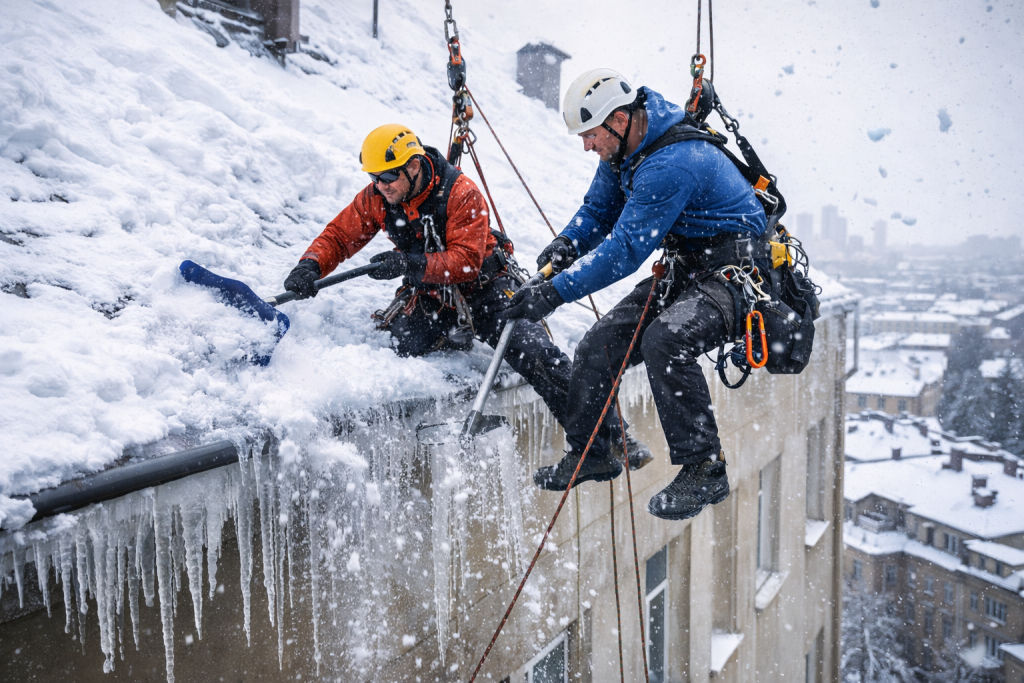
In winter, snow accumulation on roofs looks normal, but it is precisely this that causes accidents, injuries, and costly damage. Ice in gutters and icicles on eaves can break off at any moment. When the weight of the snow exceeds the calculated limit, the roof covering sags, cracks appear, the insulation deforms, and water gets into the seams. For building owners and condominium associations, this is not a matter of aesthetics, but of safety and legal liability. Therefore, snow removal should be viewed as a technical procedure rather than a response to an emergency.
When is the best time to call climbers?
The optimal moment is not when snow is already hanging over people, but when the temperature drops below zero and melting cycles begin. It is during these days that ice forms, which is difficult to remove later. Flat roofs accumulate mass evenly, creating pressure, sloping roofs form dangerous overhangs, and complex structures trap snow in areas where it is not visible. If the forecast promises warming, it is worth planning cleaning in advance. Climbers can perform work even during light snowfall, without blocking the passage and without using heavy equipment.
When it is dangerous to delay
There are times when you can’t wait — the situation can get critical within a day. Typical situations when you should call in a team of industrial climbers right away:
- active thaw after heavy precipitation, when ice appears on parapets and canopies;
- ice hanging over sidewalks, entrances, or shop windows;
- massive ice build-up in drains, blocking water flow;
- ice over parking spaces or playgrounds;
- snow accumulation at the joints of roof planes;
- visible deflections or deformations of the coating;
- repeated cycles of “thawing and freezing” at sub-zero temperatures at night.
These signs mean that the load is increasing and the danger to people and property is growing. Climbers are able to work in narrow courtyards, on high-rise facades, and in places where no equipment can reach.
Why mountaineers — a practical solution
Industrial climbing is a mobile and precise cleaning method. Teams work with safety equipment, certified gear, and clear permits. They are not limited by the lack of access or small yards. Climbers can reach any part of the roof, clean it carefully, without damaging the covering and without the risk of damaging the facade. The work is carried out quickly, with minimal disruption. Another advantage is that the process does not require additional permits or blocking sidewalks, and residents can continue to use the area. For urban development, this is the only real way to ensure safety without massive downtime and unnecessary costs.
How to prepare for a call
To ensure that the cleaning process runs smoothly and without delays, the customer should prepare some basic information. This allows us to assess the scope of work and identify risks. Checklist for the customer:
- Address of the property, number of floors, and landmarks for the entrance.
- Roof type — flat, pitched, or combined.
- Access to the roof: hatch, stairs, technical floor.
- Areas of greatest risk: entrances, canopies, crowded areas.
- Possibility of temporary traffic restrictions under the facade.
- Photos or brief descriptions of problem areas.
- Desired time frame for completion of work and forecast weather conditions.
After receiving this data, specialists plan the route, determine the attachment points, the safety zone, and the required number of climbers. This ensures strict adherence to the schedule and minimizes inconvenience to residents.
Safety and organization of the process
Snow removal work is considered high-risk, so it is only performed by experienced professionals. Before starting, the area under the facade is cordoned off, people are warned, and the equipment is checked. One member of the team monitors the area below, while another performs the work at height. Work is stopped in case of strong winds or icing of the equipment. This control prevents accidental falling debris and ensures the stability of the process. Independent attempts to knock down icicles or remove snow from windows are dangerous — they can lead to injuries and roof damage. Climbers, on the other hand, work with load calculations and precision, which allows them to complete the task without damage or risk.
Timely snow removal is a preventive measure, not an emergency response. Calling in industrial climbers before the thaw begins helps to preserve the roof, gutters, facade, and the safety of passersby. Such work is carried out quickly, in a controlled manner, and without the use of bulky equipment. The final scope of cleaning is determined after inspection or photos, and the schedule depends on the weather and access to the roof. Regular prevention in winter is the smartest way to avoid risks and unnecessary expenses.
Interesting Articles:
Lifting loads to heights for repair work: is it possible to do without heavy equipment?